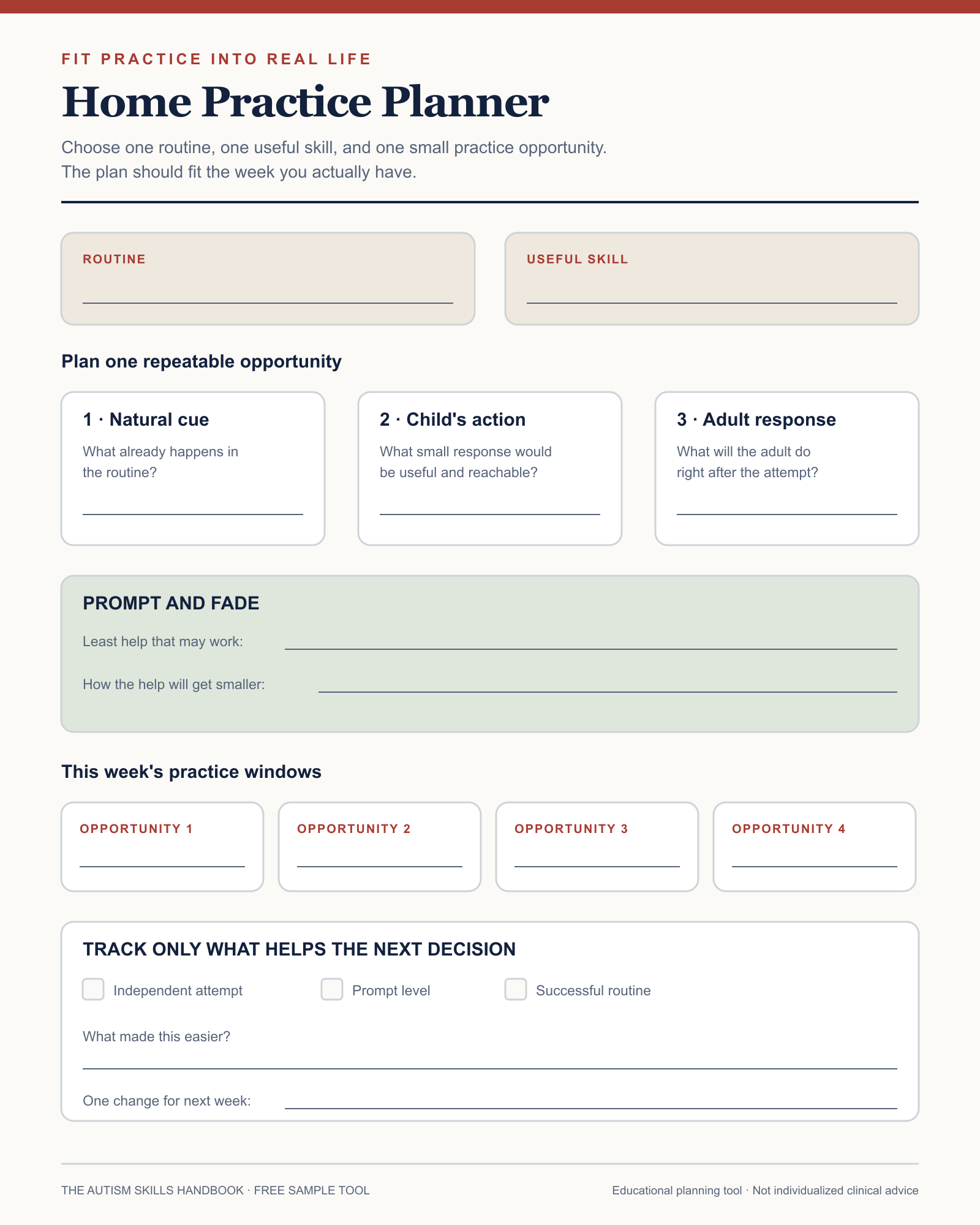
Daily routines are exhausting and home practice keeps collapsing
Start with micro-routines, transition support, and smaller plans that can survive a real week without turning the home into a second clinic.
Daily Life Guides
Guides for transitions, routines, home practice, flexibility, sleep-related planning, and making the plan survive an ordinary week.
This cluster turns daily-life friction into smaller, more teachable problems instead of treating every struggle like raw behavior.
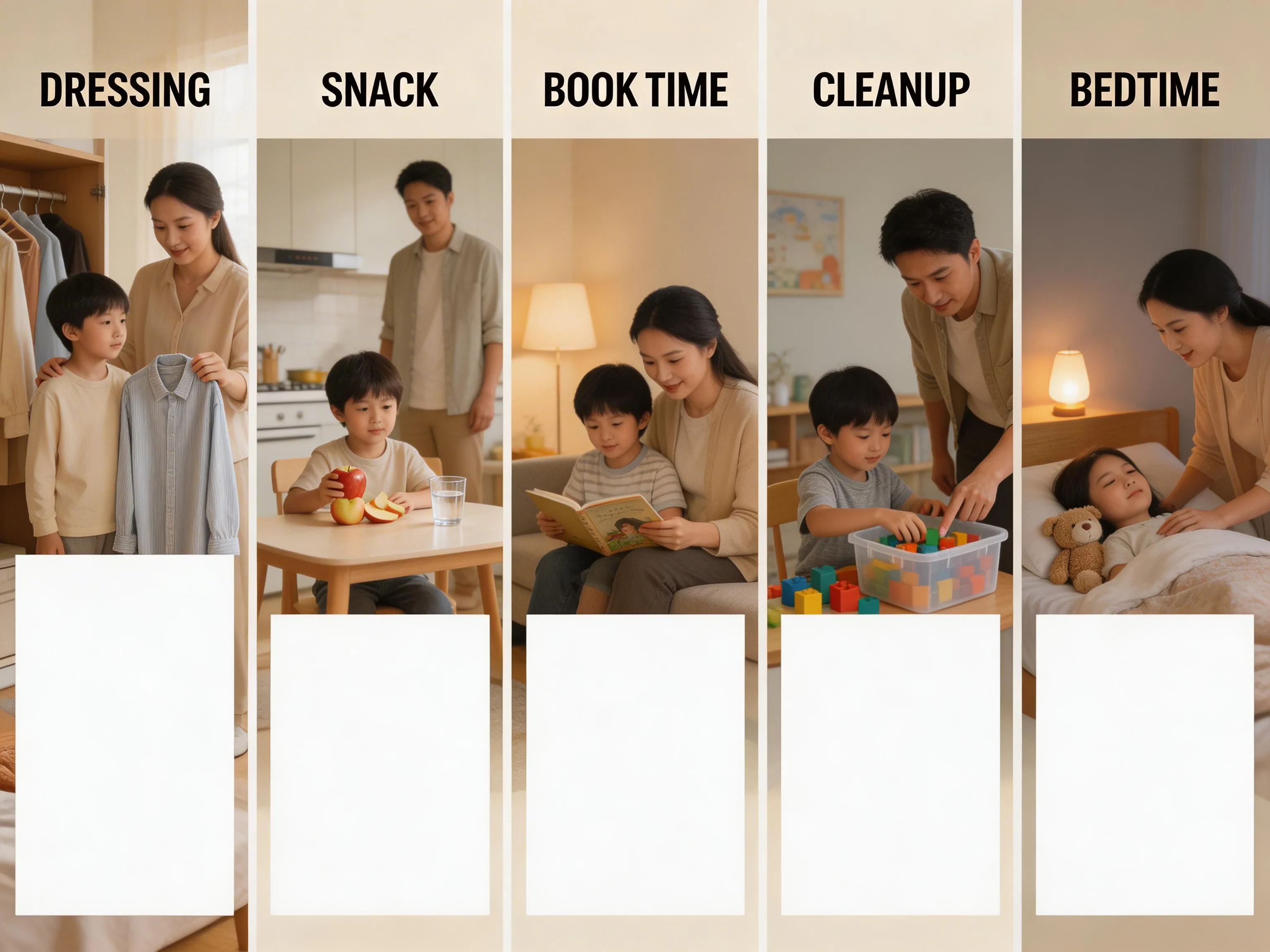
Where To Start
Start with micro-routines, transition support, and smaller plans that can survive a real week without turning the home into a second clinic.
Printable Tools
Build meal independence from one safe, preferred food and one appliance at a time while preserving sensory, motor, and communication access.
Review daily living skills by routine, mark the support that works now, and choose one useful next step without turning the list into fifty new goals.
Teach one complete clothing cycle—from hamper to closet—with machine-specific visuals and a plan for timers, sensory access, and errors.
Teach money through real decisions, accessible tools, and fraud protections—not arithmetic worksheets alone.
Teach one meaningful route in layers—from planning and rehearsal to supported rides and recovery from ordinary errors.
Observe patterns and remove access barriers before selecting a teaching plan; treat pain, constipation, fear, and sudden regression as health information.
Break tooth brushing into observable steps, solve access barriers first, and fade adult help without removing useful supports.
Separate choosing clothes, orientation, fasteners, sensory access, and initiation so one difficult step does not hide the skills already present.
Teach waiting as a predictable, measurable skill—not a vague demand to stay quiet until an adult decides the wait is over.
Teach the health-critical sequence while separating hygiene requirements from sensory, motor, communication, and initiation barriers.
All Daily Life Guides
The best home practice plan is the one a family can still do next week. When every interaction becomes a teaching moment, the home stops being a home.
The best home plan is not the most impressive plan. It is the one a family can still do next week.
Many programs jump to pretend play scripts before building the engagement, turn-taking, and shared enjoyment that make play meaningful. That sequence creates performance, not play.
Rigidity often serves a purpose. The way to build flexibility is not to introduce chaos but to make small, predictable changes the child can handle.
Transitions often fail because adults treat them as behavior-only problems. The missing skills are usually broader: predictability, communication, flexibility, and tolerance for change.
In-Depth Guides
Stop treating home practice as a second therapy session. Build real skills through micro-routines that fit your actual life — without the burnout.
Meltdowns are not behavior problems — they are skill gaps made visible. Learn what drives them, how to reduce transitions friction, and what to do when they happen.
Play is not a break from learning — it is the engine. Learn what play stages matter, how to expand rigid patterns, and how to build play skills that transfer to peer interaction.
In The Handbook
The full book covers daily life across 3 dedicated chapters with detailed frameworks, decision tools, and planning sheets.
Related Appendices