
Your child eats the same breakfast every morning. The same bowl. The same spoon. The same order. If anything changes — a different cup, a missing item, the cereal poured before the milk instead of after — the morning falls apart.
Someone tells you the child needs to learn flexibility.
They are probably right. But the way most people try to teach flexibility makes the problem worse, not better.
Why rigidity exists
Before trying to change rigid behavior, it helps to understand why it is there.
For many autistic children, routines and sameness are not preferences. They are management systems. The child is living in a world that often feels unpredictable, overwhelming, or hard to process. Routines create pockets of certainty. If the morning always goes the same way, the child does not need to figure out what happens next. They already know.
Rigidity, in this sense, is a solution. It reduces anxiety, lowers processing demands, and makes life manageable.
That does not mean rigidity should never be addressed. Some routines become so inflexible that they prevent the child from functioning in new settings, tolerating necessary changes, or adapting to the normal unpredictability of life.
But it does mean that how you address it matters enormously. If you remove the child’s management system without providing something better, you are not building flexibility. You are removing safety.
Why surprise changes backfire
The most common approach to “teaching flexibility” is to introduce unexpected changes and help the child cope with them. Change the routine without warning. Take a different route. Cancel the expected activity.
This is sometimes called exposure or desensitization. The idea is that the child will learn to tolerate change by experiencing it.
For some children, in some contexts, with sufficient support, this can work. But far more often it backfires, because the child does not experience the change as a learning opportunity. They experience it as a threat.
When the response to unexpected change is distress, and the distress is repeated, the child does not become more flexible. They become more vigilant. They grip their routines more tightly because now they know that even safe things can be disrupted without warning.
The lesson the child learns is not “change is okay.” The lesson is “I cannot trust that things will stay the same, so I need to control even more.”
This is the opposite of flexibility.
A different approach: graduated, predictable change
Building real flexibility requires a different strategy. Instead of introducing surprise changes and helping the child survive, you introduce small, planned changes that the child can handle successfully.
The key principles:
Start inside preferred routines. Do not start by changing things the child barely tolerates. Start by changing small, non-critical details within routines the child enjoys and feels safe in.
Make changes predictable. Tell the child what will be different before it happens. Use visual supports to show the change. The goal is not to catch the child off guard. The goal is to show them that change can happen and they can manage it.
Change one thing at a time. If the morning routine has ten steps, change one. Not the most important one. A small, peripheral detail. A different colored cup. A slightly different order for two steps. One variation, not a rewrite.
Reinforce tolerance, not just compliance. When the child handles a change without distress, notice it. This is different from making them push through a meltdown. You are reinforcing the experience of change going well.
The flexibility ladder
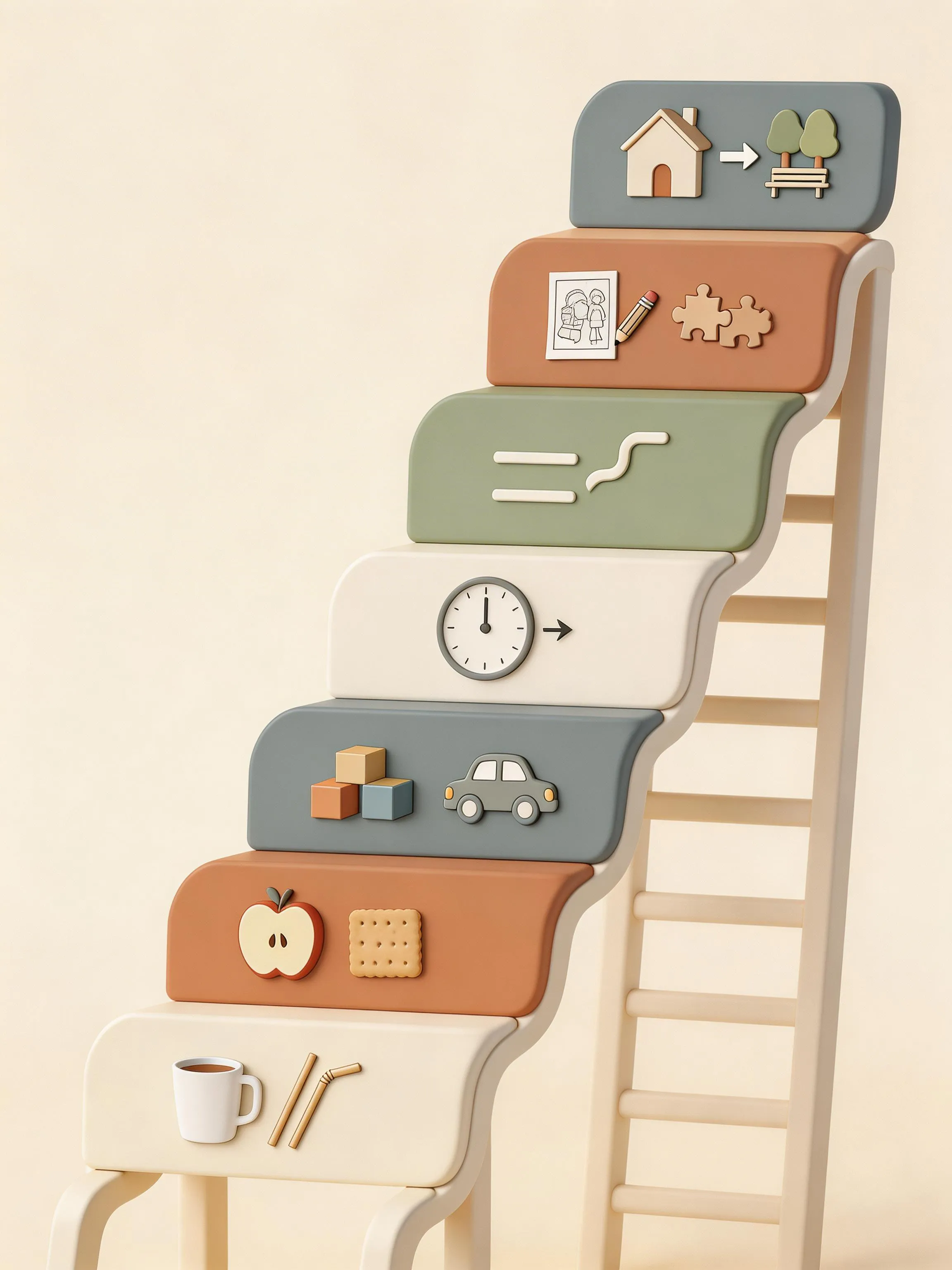
Think of flexibility as a ladder with several levels. The child does not need to jump from rigid to flexible. They climb.
Level 1: Micro-variations in preferred routines
At the bottom of the ladder, you are changing the smallest possible detail in a routine the child already enjoys.
Examples:
- Using a different cup for a preferred drink
- Sitting in a slightly different spot for a familiar activity
- Changing the order of two non-critical steps
- Using a different brand of a preferred snack
These changes are low-stakes. The core routine is preserved. The child has one small thing to tolerate, not a complete disruption.
If even this level produces significant distress, the change was too large or the child needs more support before attempting it. Back up. Make the variation even smaller.
Level 2: Planned changes with visual support
Once the child can tolerate micro-variations, you move to planned changes that are slightly larger but still predictable.
This is where visual schedules become essential. A visual schedule shows the child what will happen, including the change. The child can see it coming. They can process it before it arrives.
Examples:
- Using a visual schedule that shows a new activity replacing a familiar one
- Previewing a different route to school with a map or photos
- Showing the child a picture of a new food that will appear at lunch alongside familiar foods
- Creating a “change card” that signals when one thing will be different today
The change is real, but the child knows about it in advance and has a visual tool that makes it concrete instead of abstract.
Level 3: Flexible routines with choice
At this level, the child begins to participate in choosing among acceptable variations. Instead of everything being fixed, some elements become flexible by design.
Examples:
- The child chooses between two snacks instead of always having the same one
- The child picks which activity comes first from a set of two or three options
- The morning routine has a “wild card” slot where the child decides what goes there
- The family has two possible routes to a regular destination and the child helps choose
This builds the idea that variation is normal, safe, and sometimes even desirable. The child is not losing control. They are gaining agency within a flexible structure.
Level 4: Tolerating unplanned changes
This is where most people start, but it should come last. Only after the child has a track record of handling planned changes successfully should you begin working on tolerance for unplanned ones.
Even here, you scaffold. When an unexpected change happens:
- Acknowledge it clearly. “The plan changed. Here is what is happening instead.”
- Provide a visual update if possible. Cross out the old activity. Write in the new one.
- Validate the difficulty. “This is hard. The plan was different.”
- Reinforce coping. “You handled that change. That was flexible.”
Over time, the child builds a bank of experiences where unplanned changes were uncomfortable but survivable. That is the real foundation of flexibility.
Using visual schedules to support change
Visual schedules are one of the most effective tools for teaching flexibility because they make the abstract concrete.
A child who is told “we are going to the park instead of the library” has to hold that change in working memory, compare it to their expectation, and adjust. That is a lot of processing.
A child who sees the library crossed out and the park written in its place has a concrete, external reference. The change is visible. It is not a surprise happening inside their head. It is a fact on the board.
Visual schedules also allow you to introduce the concept of “sometimes different.” Instead of every day looking identical, the schedule can show that most things stay the same while one or two things may change. The child learns to expect consistency with room for variation.
Chapter 17 of The Autism Skills Handbook covers visual supports in detail, including how to design schedules that support flexibility rather than reinforce rigidity.
How to tell if flexibility is growing
Real flexibility looks different from exhaustion or compliance.
Signs of growing flexibility:
- The child notices a change and adjusts without extended distress
- The child talks about or references a change without becoming rigid about preventing it
- The child tolerates a variation in one routine and begins tolerating variations in others
- The child begins to suggest changes themselves
- Recovery time after unexpected changes gets shorter
Signs the child is coping, not growing:
- The child tolerates changes but is visibly stressed throughout
- The child seems to accept changes during the day but becomes more rigid about other things, as if compensating
- Meltdowns decrease in one area but increase in another
- The child becomes passive rather than flexible — they stop reacting but also stop engaging
If you see the second pattern, you may be moving too fast. The child is not learning flexibility. They are learning to shut down in the face of change. That is survival, not growth.
Common mistakes
Changing too many things at once. If you change the cup, the spoon, the order, and the cereal on the same morning, you have not taught one lesson about flexibility. You have overwhelmed the system.
Treating all rigidity the same. Some rigid behaviors serve important regulatory functions. Others are genuinely limiting. Prioritize the ones that actually prevent the child from functioning rather than the ones that are merely inconvenient for adults.
Removing supports too quickly. If visual schedules are helping the child tolerate change, do not pull them as soon as things improve. They are working because they are there.
What this means for daily life
Teaching flexibility is not a separate program. It is something that happens inside the routines you already have.
Every meal, every outing, every bedtime is an opportunity to introduce one small, manageable variation. Over weeks and months, these accumulate. The child builds a history of changes that went fine. That history becomes the foundation for handling bigger changes later.
Chapter 18 of The Autism Skills Handbook provides a practical framework for planning flexibility targets, choosing the right level of challenge, and tracking progress over time. It includes guidance on building flexibility into home routines without turning daily life into a therapy session.
Start small. Make it predictable. Let the child succeed. Build from there.
The Autism Skills Handbook provides a complete system for building flexibility, from micro-variations in daily routines to handling unexpected changes. If you want a structured, graduated approach that actually works without making life harder for your child, the handbook gives you the plan.