
Transitions are some of the most common friction points in daily life.
Adults often experience them as sudden behavior problems:
- leaving the house
- ending screen time
- changing activities
- getting ready for bed
- moving from preferred to non-preferred tasks
But the visible behavior is usually not the whole story.
Transitions are rarely just about compliance
When a transition is hard, the missing skills may include:
- predictability
- tolerance for interruption
- communication for protest or help
- flexibility when the plan changes
- trust that something understandable is coming next
That is why commands alone often fail. The child may not only be refusing. The child may be struggling with the whole shift process.
Routines are useful until they become brittle
Routines reduce uncertainty. That can be helpful.
The problem starts when routines become so rigid that any change feels like collapse. A child who can only succeed under one exact sequence has not yet built enough flexibility for ordinary life.
The goal is not to destroy routines. The goal is to use routines as scaffolding while gradually building tolerance for small changes.
Adults often make transitions harder
Common mistakes include:
- changing demands too abruptly
- offering no warning at all
- using too much language in a stressed moment
- prompting after distress has already escalated
- expecting flexibility without teaching it
These mistakes are understandable. They are also common reasons transitions stay hard.
What usually helps
Good transition support often includes:
- simple previewing
- clearer first-then structure
- useful communication options like help, wait, or finished
- small, teachable flexibility steps
- realistic expectations for processing time
The point is not to make every transition frictionless. The point is to make them more learnable and less chaotic.
Build flexibility gradually
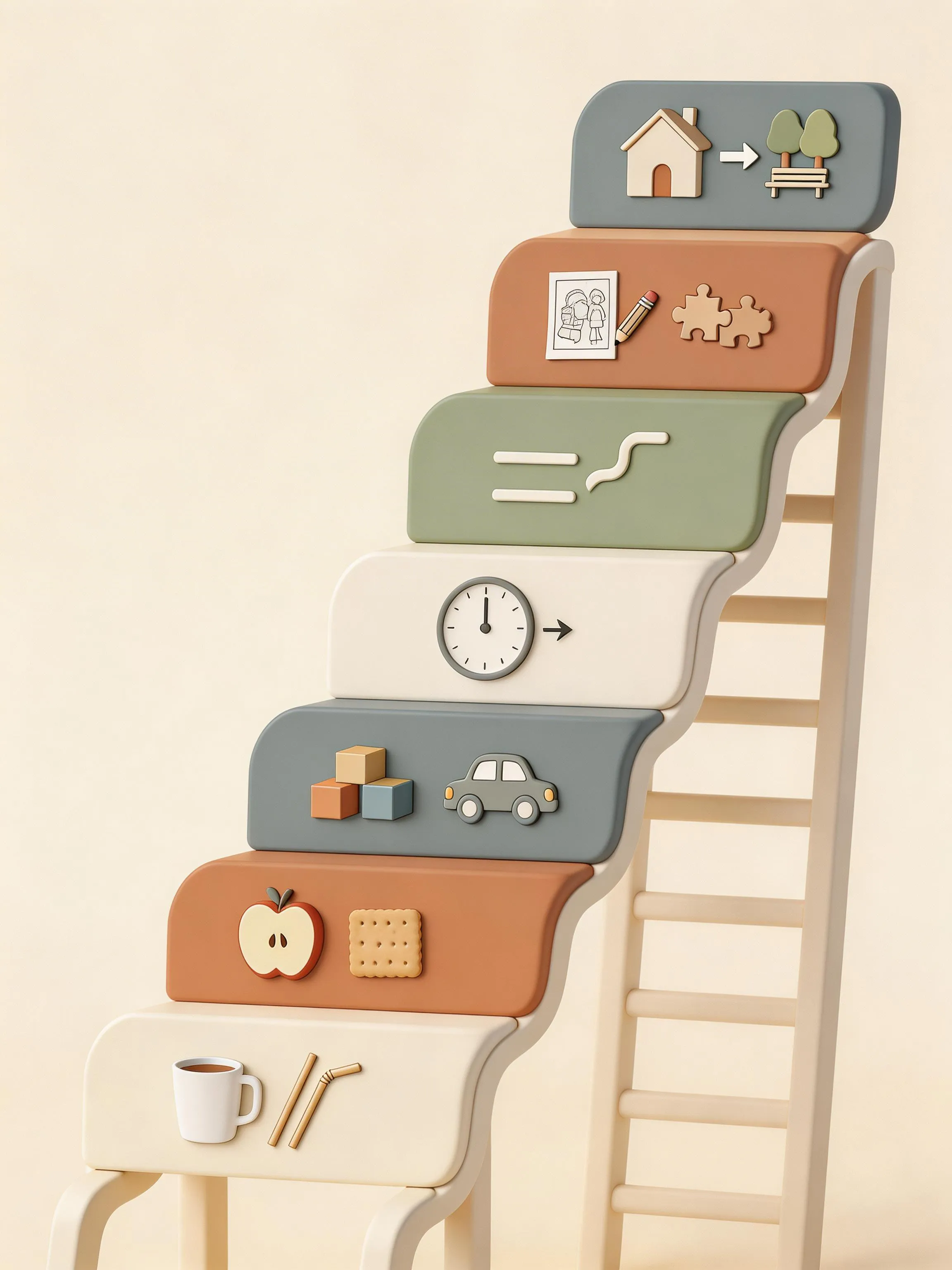
Flexibility usually grows from smaller changes to bigger ones:
- one small variation in a familiar routine
- one delayed preferred item
- one different order of events
- one slightly changed transition cue
That is often more effective than suddenly demanding full adaptability.
Read next
If home carryover itself is breaking down, read Autism Home Practice Without Burnout.
If you want the broader framework for routines, behavior, and real-life participation, see the book.